
Why is it also worth
visiting Basel?
Basel
Basel is located at the Three-Country Corner of Switzerland, Germany and France – a city that combines European charm, centuries of history and first-class economic strength all within a very small area. If you stay for two or three days, you’ll discover a blend that you’ll hardly find in any other Swiss city.
Geographic Location – in the Heart of Europe
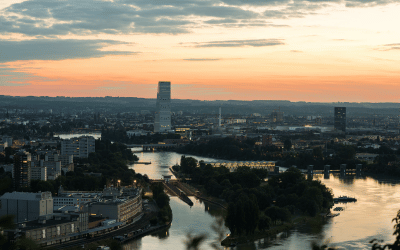
Basel lies at the bend in the Rhine, where Switzerland, Germany and France meet – the famous “Three-Country Corner.” From the city center, you can reach Germany (Weil am Rhein, Lörrach) or France (Saint-Louis, Huningue) in just a few minutes.
This location has always made Basel a hub for trade and cultural exchange and explains why the city has such an international character.
Well connected – Easy to Reach from Anywhere
EuroAirport Basel-Mulhouse-Freiburg (BSL): an airport jointly operated by France and Switzerland, located just about seven kilometers from the city center, with direct flights to many European cities and intercontinental connections via Zurich, Frankfurt or Paris. Bus 50 takes you to the main train station in about 15–20 minutes.
TGV Lyria to Paris: The trip takes about three hours along the 600-kilometer route, with top speeds of up to 320 km/h – so a quick trip to Paris is easily doable.
• Zurich: only about 53 minutes away by train (direct service, approximately every 20–30 minutes).
• Geneva: just over 2 hours and 51 minutes by train.
• The German A5, French A35 and Swiss A2/A3 highways converge directly in Basel; it’s about a three-hour drive to Frankfurt and about a five-hour drive to Paris.
Hardly any other Swiss city is so seamlessly connected to three countries and their rail and air networks.
The city’s reddish sandstone landmark, perched high above the Rhine, is the perfect starting point for any visit to Basel. Basel Cathedral – originally Romanesque, expanded in the Gothic style in the 14th century, with its characteristic glazed-tile roofs and two unequal towers (St. George’s Tower and St. Martin’s Tower) – is one of Switzerland’s most striking buildings. Inside lies the tomb of Erasmus of Rotterdam, who lived and died here. From the Pfalz, the terrace behind the cathedral, you have one of the most beautiful views of the Rhine – a place where you’ll want to linger, especially at sunset.
Surrounding the cathedral is the medieval old town, featuring the magnificent town hall on the market square (bright red with rich frescoes), narrow alleys, guild houses and small squares. The Mittlere Brücke connects Grossbasel and Kleinbasel – the two historically distinct districts on either side of the Rhine. Taking a dip in the Rhine’s swimming currents – known as the “Rhywäscheritter”– in the summer, with the waterproof “Wickelfisch” as a bag for your belongings, is part of the Basel way of life.
Basel has more museums per capita than any other Swiss city and is internationally regarded as an art metropolis.
Kunstmuseum Basel: the oldest publicly accessible art collection
in the world (Basel’s art treasures date back to the 17th century), now featuring masterpieces ranging from Holbein to Picasso.
Fondation Beyeler in Riehen: designed by Renzo Piano, it houses one of the most significant private collections of classical modern art (Monet, Picasso, Giacometti, Rothko) in a light-filled building set amid parkland.
The Tinguely Museum, Schaulager, Vitra Design Museum (just across the border in Weil am Rhein) and the Museum of Contemporary Art round out the offerings.
Art Basel, the world’s leading fair for modern and contemporary art since 1970, transforms the city into the epicenter of the international art world for one week every June.
Basel Fasnacht – Switzerland’s largest and oldest carnival celebration, designated a UNESCO World Cultural Heritage site in 2017 – also demonstrates how deeply culture and tradition are intertwined in Basel.
Basel is a city of patrons and foundations. In addition to the Fondation Beyeler, numerous private and corporate foundations shape the city’s cultural and social life – funded in no small part by the prosperity of the pharmaceutical and chemical industries and long-established Basel families. Many of the city’s museums, concert halls and social projects bear their mark, giving Basel an extraordinary cultural richness relative to its size.
Hardly any other city of this size attracts so many star architects. Herzog & de Meuron, the Pritzker Prize laureates, are from Basel and have designed numerous buildings here, including the Messe Basel with its wave-shaped facade. Just across the border lies the Vitra Campus in Weil am Rhein—featuring buildings by Frank Gehry, Zaha Hadid, Tadao Ando, SANAA and Herzog & de Meuron – a must-see for any architecture lover. The Roche Tower (Building 1, by Herzog & de Meuron), at just over 205 meters the tallest building in Switzerland, also makes a striking impression on the skyline.
Basel loves to eat – and eats well. Among the culinary classics are Basler Mehlsuppe (traditionally eaten at the end of Carnival) and Basler Läckerli, a honey-spiced cookie with a centuries-old tradition. The city has a vibrant dining scene, ranging from rustic taverns along the Rhine to elegant fine-dining establishments and restaurants that have earned multiple Michelin stars – the proximity to France and Germany is evident on the plates. Coffeehouse culture, pastry shops and weekly markets (such as those on Marktplatz or Barfüsserplatz) invite you to stroll and sample the local delights.
Basel offers accommodations of the highest caliber. The Grand Hotel Les Trois Rois, located directly on the Rhine, is one of the oldest and most historic hotels in Europe and has been hosting state guests and dignitaries for centuries. Other upscale hotels include the Teufelhof, the Hotel Basel, the Radisson Blu and the Swissôtel Le Plaza. During Art Basel and the Watch and Jewelry Fair, good rooms are in high demand—so it’s worth booking early.
Basel is not only a cultural and pharmaceutical hub, but also a major player in the global
financial system:
Bank for International Settlements (BIS): Founded in Basel in 1930, it is the world’s oldest international financial organization and is often referred to as the “central bank of central banks.” Every two months, central bank governors from around the world – including representatives of the U.S. Federal Reserve (Fed) and the ECB – meet here to discuss monetary policy. Montagu Norman, Governor of the Bank of England and Hjalmar Schacht, President of the Deutsche Reichsbank, originally founded to handle German reparations payments.
Basel III: The BIS is also home to the Basel Committee on Banking Supervision – the body that, following the 2008 financial crisis, developed the globally applicable Basel III capital adequacy requirements for banks
. Basel is thus the place where the global rules for the
banking world are established.
UBS: Today’s UBS was formed in 1998 through the merger of the two Swiss
major banks, Schweizerischer Bankverein (founded in 1854/1872 in Basel) and Schweizerische Bankgesellschaft. The merger was driven by globalization and the
deregulation of international financial markets and created Switzerland’s largest bank. To this day, Basel remains one of UBS’s two main headquarters alongside Zurich and was the institution’s actual birthplace.
Swiss Bankers Association: The umbrella organization for Swiss banks is also headquartered in Basel – further evidence of how deeply the city is historically intertwined with the Swiss banking sector.
Insurance: Basel is also a major insurance hub – Helvetia Baloise Holding (which, following the merger of Helvetia and Baloise at the end of 2025, will be the second-largest Swiss insurance group) has its headquarters on Aeschengraben in Basel; Baloise itself was founded in Basel as early as 1863.
This concentration of international financial institutions – ranging from the world’s oldest international financial organization to the birthplace of a major Swiss bank – makes Basel a city with a unique standing in the global financial architecture.
Why a Longer Stay Is Worth It
Basel is a city you can get a taste of in a day, but you really need two or three days to experience it fully: a morning at the cathedral and in the Old Town, an afternoon at the Fondation Beyeler or the Kunstmuseum, an evening by the Rhine enjoying a good meal, a trip to the Vitra Campus or to Alsace, a walk through three countries in a single afternoon. If you then add the short train ride to Zurich or the three-hour trip on the TGV to Paris, you’ll quickly realize: Basel is not just a destination, but also an excellent starting point—compact, sophisticated and with a history that spans from medieval guilds to the most powerful institutions in the global financial world.